

















What is the Difference Between The Superconscious, Conscious and Subconscious Mind?
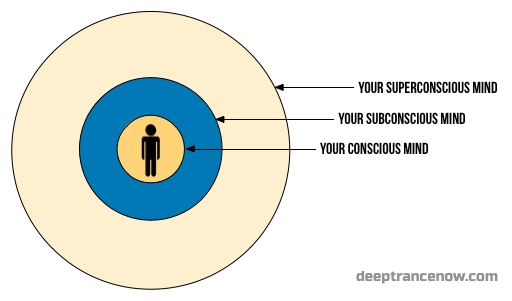
There is only ONE MIND - which is for the sake of convenience and understanding divided, according to its functions, into three function of the one mind: conscious, subconscious and superconscious.
The term Superconscious Mind stands for this One Mind - for universal consciousness, for totality of all knowledge, information and power - called by various names Universal Mind, The Infinite Mind, The Universal Consciousness, The Source, Divine Mind, Light, God Mind, or simply God.
Superconscious mind is omnipresent, ONE MIND expressing through all, and each human mind is only an individualized center of consciousness of this ONE MIND. Contrary to the popular opinion, your mind is not in your body, your body is in your mind.
The term Subconscious Mind stands for your individual accumulation of knowledge through personal experience. Your subconscious mind contains all of your past programming, your samskaras (mental and emotional imprints from the past), your beliefs about yourself and the world around you.
Spiritual literature uses the term "soul" to refer to subconscioud mind. Spiritual literature also refers to the subconcious mind in expressiongs "as you think in your heart", or "as you believe in your heart".
Your subconscious is a storehouse of all your thoughts and feelings, which together release a VIBRATION. This vibration through the Law of Resonance and Attractions manifests in your experience everything that resonates with that vibration.
The term Conscious Mind stands for whatever you are currently consciously aware of.
If you are conscious aware of your left toe, you can say that it is in your conscious mind. When you are mentally preoccupied with other things, and the intelligence of your body is taking care of your toe, you can say that your left toe is in your subconscious mind.
The Unconscious Mind
Ericksonian hypnotists and psychologists may use the term Unconscious Mind, to refer both to Subconscious and Superconscious Mind - in other words, for everything that is happening out of your conscious awareness.
Hypnotists who are teaching hypnosis according to NGH curriculum, use the term Unconscious Mind to refer to functions of the body they belive are out of your range of control.
In hypnosis ...
When people use the term "hypnosis", they are generally referring to accessing the subconscious mind. Your subconscious mind contains only your past experiences and knoweldge.
Even though you are free to access the INFINITE knowledge, resources and power from your Superconscious Mind, many hypnotists and people using self-hypnosis tend to focus only on programming subconscous mind with ideas that originate from the limited information obtained through past experiences.
This is sometimes sufficient, depending on what goals you desire to achieve. However, if you are faced with a challenge that seems to be greater than anything you know based on your past experiences, or you simply desire to keep unfolding your limitless potential, to do that, you'd have to access your superconscious mind.
While all kinds of things may be impossible for your individual self to accomplish, nothing is impossible for your Infinite Superconscius Self, and you can experience it in your daily life as you allow more and more of your Infinite Self to express through you.
Your Superconscious Mind is FREE
From Any Limitations FOREVER
Whatever limitations you are experiencing are strictly due to the limiting beliefs you hold in your subconscious mind.
The way to overcome them is by aligning your conscious and subconscious minds with the superconscious mind. You do this by being willing to let go of your own beliefs about yourself and the world around you and opening yourself to the information, the power and the love flowing into "your center of consciousness" directly from the superconscious mind. In spiritual literature this is often referred to as surrendering to God.
Some people are wary of the term "surrender", but it is just another way of saying "allowing" or "opening" yourself up to the flow of boundless resources, knowledge and power which are available to you.
In the process of surrender, as you begin to express more and more of your infinite potential, you begin to identify with your Infinite Self, with your God Self, instead of with your limited physical self. Then you discover that the only thing that you were surrendering is yuor limited individual self to our All-Encompassing Infinite Superconscious Self, and as you did all kinds of limitations were spontaneously erased from your mind and your life, and miracles and wonders followed you wherever you went.
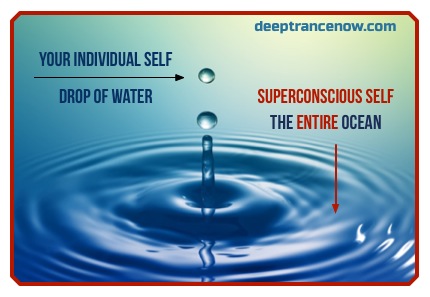
Your individual self is like a drop of water. Your superconscious is like an ocean. To a drop of water it is impossible to push a boat on its own, but as part of an ocean it can accomplish anything.
A drop of water fully surrendered, and merged with an ocean doesn't think of itself as a mere drop of water, it thinks and acts as an ocean.
When you begin to identify yourself not with your body, but with the ALL, more and more of the attributes of your Superconscious Self begin to express through you - power, wisdom, love. You feel at peace.
As you let this this boundless power flow through you, you may experience it as electricity running through your body. You may feel all buzzed up, which is why it is so exciting and electrifying exploring your limitless potential. It feels awesome.
Your heart may well up with feeling of gratitude and you may find yourself crying at times fro the sheer wonder and grandeur of these new experiences. You may experience odd symptoms in your body, as your whole being is adjusting to be a conduit for more power.
De-Hypnotizing or Undoing Yourself ...
The process of engaging the superconscious mind is often referred to as de-hypnosis - the goal is to de-hypnotize yourself from the limiting beliefs you accepted about yourself and your relationship to the world around you.
Just like in an ordinary hypnosis session, your mind is one-pointedly focused on your outcome, except that what you are focusing upon is not any particular manifestation or solving of a problem, but the experience of your Infinite Superconscious Self.
During traditional hypnosis or hypnotherapy sessions - you'd work with a hypnotist or hypnotherapist on one specific issue at the time - an issue that is presenting a challenge for you. The process generally consists of changing the beliefs you hold in your subconscious mind regarding the specific issue.
Some hypnotists may also attempt to help you get rid of the problem by providing guidance to help you get into a relaxed state and then just repeating over and over the direct suggestion which is meant to help you get rid of the problem (e.g. for weight-loss, "You're slim now", or for smoking cessation, "You're a non-smoker now"). Since this approach does not deal with any possible benefits you are deriving from your current challenge (secondary gains), the effectiveness of this approach-may be questionable.
If, instead, you chose to engage in the process of de-hypnotizing yourself and engaging the superconscious mind - even though you may not be directly focusing on any specific issue, you may discover that the challenges you were facing before simply begin to fall away.
If you were having a weight-problem, you could experience an inner urge to engage in activities and nutrition that promotes your ideal weight. If you were having a challenge with substance abuse, you could experience that any desire and/or need for the particular substance has simply vanished without any withdrawal symptoms.
You access the superconscious mind through your subconscious, so the process of accessing it is the same as accessing the subconscious through hypnosis. The difference lies in what you do next.
Open Yourself To The Experience Of Oneness
Instead of pounding more of your own suggestions and beliefs into your subconscious, you open yourself to the experience of ONENESS.
You begin by putting aside all of your previous beliefs about yourself or about the world-around-you. Then:
"Stop for a moment and just think of the tallness of God or Primal Cause with no beginning or end, with universal scope, and surround yourself in this. As you become faithful and worship this, and this alone, ONE GOD, ONE ALMIGHTY PRESENCE - you will find that the vibrations of your body will change from the human to the God or Primal vibration. As you think, live, move and become one with this vibration, you do worship; and what you worship, you idealize, you become." (Life and Teaching of the Masters of the Far East)
You may also just sit and relax and contemplate the ATTRIBUTES of this ONE ALMIGHTY PRESENCE - LOVE, LIGHT, OMNIPOTENCE, OMNIPRESENCE, OMNISCIENCE, TIMELESSNESS, etc.
What you'll discover the more you align your conscious and subconscious mind with your superconscious is that whatever you may want will spontaneously and effortlessly appear in your life, often instantaneously after the thought occurred to you. As you think a thought and next moment you see it manifested in front of you, you will feel as if the world around you is only a projection of your thoughts, which, in fact, it is.
One of the books that will help you get into this state of mind is A Course in Miracles.
You can also benefit from working with Spiritualy-related recordings on this page- like Oneness, Illumnation, Love.
The Science of Manifesting
- from thought to matter -
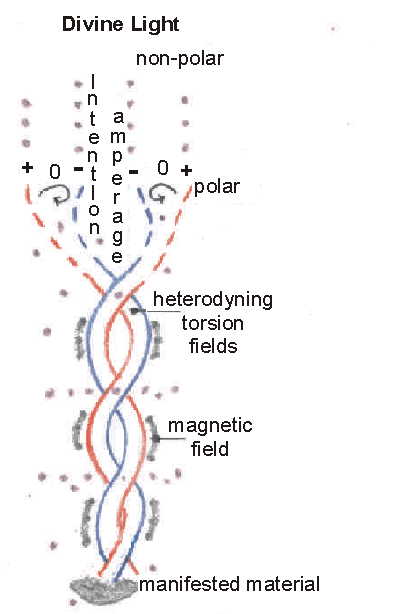
The term manifest is used continuously with no thought given to how it is possible. Material just does not appear from nothing. To manifest means to make certain by transitioning into the human visual range. The drawing below suggests one of the methods used. Sub-atomic particles (Divine Light) are linear and non-polar.
When intention is introduced, the subtle particles slow and transition into cyclonic events. Cy means complimentary state of action and of course clone means a copy of an original form. This implies that everything in the universe is manifested Divine Light.
The process can be visualized by imagining two bathtub drains, one in the north hemisphere and one in the south. In the tub there is no polarity. By intent, Divine Light slows forming whirlpools which acquire plus and minus in the outer bands and neutral at Walter Russell's fulcrum or Gregg Braden's zero point. Each drain sets up a torsion field, and because of the plus and minus fields we have heterodyning torsion fields. Any two of the inside bands spinning toward each other, are attracted (likes attract at that speed) and begin to form filaments which wrap like planetary nodes, chakras, DNA and flesh.
That which has manifested is continuously bombarded with Divine Light. This causes thrust and spinning and sets up a magnetic field around the materialized object. Absolute knowledge dwells in the Light, so it is easy to see how it is obscured in the denser fields or circuits.
adapted from Theodynamics
Neuro-Theology
Neuro-theology is a broad effort by scientists around the world to better understand spiritual experiences, measure them, and even reproduce them. Using powerful brain imaging technology, researchers are exploring what mystics call nirvana, and what Christians describe as a state of grace. Scientists are asking whether spirituality can be explained in terms of neural networks, neurotransmitters and brain chemistry.
"The brain is set up in such a way as to have spiritual experiences," said Andrew Newberg, a Philadelphia scientist who wrote the book "Why God Won't Go Away." "Unless there is a fundamental change in the brain, spirituality will be here for a very long time. The brain is predisposed to having those experiences and that is why so many people believe in God."
Newberg's experiment consisted of taking brain scans of Tibetan Buddhist meditators as they sat immersed in contemplation. After giving them time to sink into a deep meditative trance, he injected them with a radioactive dye. Patterns of the dye's residues in the brain were later converted into images.
Newberg found that certain areas of the brain were altered during deep meditation. Predictably, these included areas in the front of the brain that are involved in concentration. But Newberg also found decreased activity in the parietal lobe, one of the parts of the brain that helps orient a person in three-dimensional space.
"When people have spiritual experiences they feel they become one with the universe and lose their sense of self," he said. "We think that may be because of what is happening in that area -- if you block that area you lose that boundary between the self and the rest of the world. In doing so you ultimately wind up in a universal state."
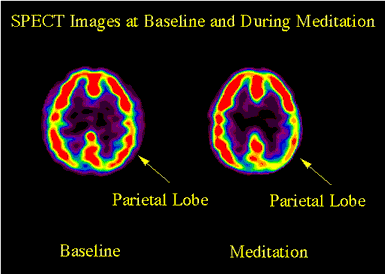
SPECT (single photon emission computed tomography) imaging allows to image the brain and determine which areas are active by measuring blood flow. The more blood flow an area has, the more active it is. The image above shows the results from a baseline scan on the left (i.e. at rest) and during a "peak" of meditation shown on the right.
The image on the left shows that the front part of the brain, which is usually involved in focusing attention and concentration, is more active during meditation. This makes sense since meditation requires a high degree of concentration. The image on the right shows that there is decreased activity in the parietal lobe. This area of the brain is responsible for giving us a sense of our orientation in space and time. Drs d'Aquilli and Newberg hypothesized that blocking all sensory and cognitive input into this area during meditation results in the sense of no space and no time which is so often described in meditation.